Zaragoza – Teruel – Valencia – Barcelona
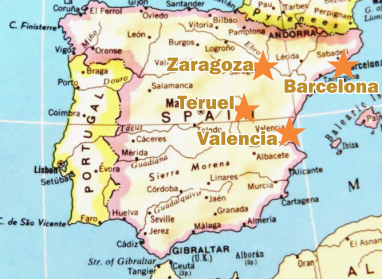
When we learned that Susan had a conference in Barcelona, we started thinking about where else we could explore in northeastern Spain. We briefly considered the Pyrenees but decided against renting a car. Phil had visited Zaragoza a few years ago and was taken with its architecture, so we decided to explore Zaragoza, nearby Teruel, and then head south to Valencia.
Throughout our trip, despite being in the heart of regions severely affected by catastrophic flooding, we managed to dodge the rain for all but one evening. Just hours after we left, our neighborhood in Barcelona was completely inundated. If you think climate change is wreaking havoc here, Spain’s suffering is beyond comprehension. In summer, new wind patterns bring blistering Saharan air, triggering temperatures above 110°F, nationwide droughts, and devastating wildfires. In autumn, sea-effect storms dump 2–4 inches of rain per hour along the Mediterranean coast, turning streets into raging torrents. Some areas have been pelted with golf-ball-sized hail, and new weather patterns have caused unprecedented downpours along the northern coast.
Adding to the local tension was the “Maricarmen incident”: an 87-year-old woman was forcibly evicted from the apartment where she had lived nearly her entire life. After massive nationwide protests, the landlord relented and allowed her back at her original rent. Tragically, she passed away just days later. At the same time, political factions have seized upon the ongoing Ceuta migrant crisis.
Zaragoza
Zaragoza is a couple of hours by train from Madrid. As usual, navigating the sprawling Atocha Station after an overnight flight was a bit of a challenge. Once we got our bearings, we enjoyed our first delicious cortado (espresso with a dash of milk) before boarding our train. Upon arrival, we checked into our apartment—perfectly located in the old city center—and set out to explore.
Zaragoza was an important and wealthy Roman city that retained its prominence through the Visigothic, Moorish, and post-Reconquista eras. Over recent years, an impressive array of Roman ruins has been excavated and restored. The city has also preserved much of its Mudéjar architecture. The central square, Plaza del Pilar, is surrounded by buildings from various eras and was always bustling with people visiting cafes or the basilica. Sadly, the open vastness of the plaza is the direct result of heavy bombings by Franco’s forces during the Spanish Civil War which destroyed many of the original buildings.
On our first day, we stopped at the vibrant Mercado Central. The region is famous for jamón de Teruel (cured ham from Teruel), so we picked up some slices alongside some fantastic local cheese and fresh bread for our inaugural meal.
A major highlight was the Aljafería Palace, an 11th-century Islamic palace in the heart of the city. Built originally as a residence of leisure and later fortified, it has been beautifully restored. Its Moorish arches, intricate plasterwork, and carved coffered ceilings are breathtaking. Part of the complex has been modernized and now houses the Parliament of Aragon.
During our stay, we also visited the ruins of the Roman theater, the ancient baths, and the riverport warehouses that were once vital to the city’s trade. In one of Zaragoza’s many lovely parks, we explored the Ceramics Museum.
Each evening, we headed to a lively neighborhood just a few blocks from our apartment for tapas. In Zaragoza, many bars specialize in just one or two offerings, but they execute them superbly. The tradition is to hop from spot to spot, enjoying a single tapa and a small drink at each. On our first night, we had marinated mushroom skewers along with goat cheese and mushroom-ham croquettes. On our second night, we enjoyed meatballs in an orange sauce and fried squid—always accompanied by a caña (small draught beer) for Phil and a vermut or glass of wine for Susan. We loved every minute of it.
Teruel & Albarracín
After a few days in Zaragoza, we traveled south to Teruel. The entire railway line from Zaragoza to Valencia was closed for repairs (train tracks in many parts of Spain had warped during the summer heatwave, though we never learned the exact reason for this specific closure), so we took a bus instead.
The bus dropped us at the Teruel train station at the base of the hill below the historic town. After a short walk, we came across the ornate Escalinata. Constructed in 1921 to connect the station with the elevated city center, this impressive Neo-Mudéjar staircase combines detailed brickwork, wrought iron, and colorful ceramic reliefs. Heavy bags in hand, we opted for the public elevator up the hill and returned later to explore the staircase on foot.
Stepping off the elevator, the medieval center felt like something out of a fairytale. We walked beneath two soaring Mudéjar towers on our way to our lodging.
Teruel was founded in 1171 by King Alfonso II of Aragon following the Christian reconquest of the area, serving as a fortified outpost on the kingdom’s southern border. To encourage settlement, the king granted Teruel a set of local laws (Fuero), fostering a diverse community where Christians, Muslims, and Jews coexisted for centuries.
This multicultural heritage birthed Teruel’s defining artistic legacy: Mudéjar architecture (Mudéjar meaning “those who remained”). Islamic craftspeople remaining in the city applied traditional brickwork and glazed ceramic techniques to construct magnificent towers and churches, earning Teruel its reputation as the capital of Aragonese Mudéjar art. During the Middle Ages, the town also birthed its most famous folk legend: the tragic 13th-century romance of the Lovers of Teruel (Los Amantes de Teruel)—a real-life Romeo and Juliet tale.
Centuries later, Teruel became the site of one of the Spanish Civil War’s fiercest engagements. The Battle of Teruel (December 1937–February 1938), fought in sub-zero winter temperatures, resulted in immense loss of life and left much of the urban fabric devastated before Nationalist forces secured it. Carefully rebuilt in the mid-20th century while preserving its historic soul, Teruel’s primary Mudéjar monuments were designated a UNESCO World Heritage Site in 1986.
We spent a full day wandering Teruel’s streets, and the following day took a local bus to nearby Albarracín. Perched dramatically on a rocky crag with medieval walls climbing the mountainside behind it, Albarracín was founded in the 11th century by a Berber dynasty and operated as an independent kingdom until the 13th-century Reconquista. A few miles away in the surrounding hills are prehistoric rock paintings, though we couldn’t arrange transport to see them this time—next trip!
Valencia
From Teruel, we continued on to Valencia. Susan had just 24 hours here before heading to her conference in Barcelona, while Phil had four days to explore.
We were immediately struck by the city’s rich Beaux-Arts architecture—more prominent here than even in Prague. València is a bustling city that never feels overwhelmed by tourism, though it was noticeably warm and muggy for October. At the vibrant Mercat Central—a 1928 Valencian Modernism masterpiece housing over 1,000 vendors under stained glass and ironwork—we sampled the local specialty: refreshing horchata served with sweet fartons for dipping. Phil also picked out a few local olive varieties to try among the stalls of produce and cheeses.
We explored several major landmarks across the city:
Estació del Nord: Built in 1917, the main train station is a stunning example of Valencian Modernisme, featuring restored wooden ticket booths and ceramic mosaics.
Though the medieval city walls are gone, grand gateways remain. The twin pentagonal Torres de Serranos (1392–1398) once served as a prison and later stored Prado Museum masterpieces during the Civil War. Nearby, the 15th-century Torres de Quart still bear cannonball indentations from the 1808 Peninsular War.
Museu de les Roques: Easily one of our favorite stops, this 15th-century facility houses the spared festival floats (roques), giant figures, and mythical sculptures saved from the annual burning during Las Fallas, a festival in which giant satirical floats and structures are burned.
La Lonja de la Seda (Silk Exchange): This UNESCO World Heritage Secular Gothic masterpiece features a main trading hall with soaring vaulted ceilings supported by helical columns resembling palm trees, an orange-tree courtyard, and the gilded ceiling of the Consulate of the Sea.
Cathedral & Historic Churches: Built over Roman and Moorish foundations, Valencia Cathedral seamlessly blends Romanesque, Gothic, Renaissance, and Baroque styles—housing an ancient agate cup revered as the Holy Grail—and is crowned by the octagonal El Miguelete bell tower. Nearby, the Església de Sant Joan del Mercat features a striking 17th-century Baroque facade, while Santa Caterina Màrtir boasts an iconic hexagonal belfry.
Museums & Parks: The Museo de Bellas Artes holds a superb collection featuring Hieronymus Bosch, while the IVAM showcases Rodin-influenced modern sculpture. In the park along the old riverbed, ancient stone fragments at the Ruïnes Romanes i Visigodes double as casual garden seating for locals.
Side Trip: Xàtiva
Phil took a day trip 50 km south of Valencia to explore the Castell de Xàtiva, set at the foot of Mount Vernissa. Founded by Iberian tribes, expanded by Romans and Moors, and famous as the birthplace of both the Borgia popes (Calixtus III and Alexander VI) and the painter José de Ribera, Xàtiva offers a remarkable concentration of history.
Perched along a craggy ridge, the castle complex commanded the ancient Via Augusta connecting Rome to Cádiz. The fortress is divided into two sections joined by a central parade ground:
The smaller, older section, Castell Menor, sits on Iberian and Roman foundations. Local legend holds that Hannibal stayed here before launching his march across the Alps, and that his son was born on the site. The larger section, Castell Major, was fortified primarily during the Islamic period and expanded following King Jaume I’s conquest in 1244. Beyond its military purpose, it served as a state prison for high-profile political prisoners under the Crown of Aragon.
Barcelona
We reunited in Barcelona 24 hours before our flight home. Barcelona is a city that’s sadly been “loved to death.” It’s fascinating, but so heavily congested with tourists that it can be tough, perhaps impossible to fully take in. We braved the crowds for an afternoon stroll through the Gothic Quarter and managed to snag a dinner table just before the heavens opened up with torrential rains that lasted for hours. The following morning cleared up, giving us an overcast but pleasant early morning walk down Las Ramblas to admire the architecture in peace.
Our flight home was smooth, though news reached us the next day that heavy flooding had claimed two lives in Barcelona, a stark final reminder of how deeply climate change is impacting Spain.
Logistics
We rented apartments in Zaragoza, Teruel, and Valencia using Airbnb and booking.com. In Barcelona, we stayed in Grupotel Gravina, two blocks from the Plaça de Catalunya. The location was superb to explore the area, as well as being accessible to the airport, Sants Estació train station, La Rambla, and lots of restaurants. They also had one of the largest breakfast buffets we’ve ever seen.
We flew BOS-MAD on Iberia. They cancelled our return trip BCN-BOS (on Level) and automatically just rebooked us 3 days later. After a frustrating hour on the phone with indifferent staff, they finally assigned us to Delta. In sharp contrast, Delta was helpful and respectful. This could be our last trip on Iberia.
Zaragoza


Teruel


Albarracín


Valencia


Las Fallas


Xátiva


Barcelona


